
Summary
Calgary’s reputation as the affordable big city is doing a lot of work right now. Rent has genuinely come down, two years running. But prices here have been climbing faster than the national average, Alberta wage growth has slowed to roughly half the national pace, and the hourly wage it actually takes to cover a Calgary household sits more than eleven dollars above the provincial minimum. Affordable compared to Toronto? Still yes. Affordable compared to your paycheque? That depends a lot on which Calgary you’re living in.
Affordable is one of those words that only means something once you finish the sentence.
Cheaper than Vancouver, certainly. Set against what you were paying in 2019, probably not. And measured against what you actually earn, which is the only version of the question that changes anyone’s life.
We already broke down what it costs to live here. This is the other half of it: whether those costs still line up with what people in this city are bringing home.
Rent Is the Part That Genuinely Got Better
Start with the good news, because there is some.
A one-bedroom in Calgary was asking around $1,508 a month in September, down five per cent in a year. Two-bedrooms averaged $1,834, down almost as much. Nationally, asking rents have now fallen for twenty-four months straight. Calgary has been part of that trend rather than an exception to it.
If you signed a lease in 2023 and felt gouged, you weren’t imagining it. The market has since moved the other way.
Buying Has Softened, But Only Just
The resale market tells a flatter story.
CREB put the benchmark price for a typical Calgary home at $566,700 in September, down just under one per cent on the year. Row houses are off nearly six per cent at $412,400. Apartment condos have taken the real hit, down more than eight per cent to $291,400.
Detached homes have barely moved.
Which means the segment that’s become more affordable is the one first-time buyers were already circling. That’s not nothing. It also isn’t a broad correction.
Prices Here Are Climbing Faster Than the National Average
This is where the picture turns.
Calgary’s inflation rate hit 4.2 per cent year over year in July, up from 3.4 per cent the month before. Nationally, inflation has been running closer to three per cent.
The biggest driver wasn’t housing. It was transportation, which added more than two percentage points to the Alberta number by itself. Shelter inflation has actually been mild, around 1.8 per cent nationally, and food has been similar. The squeeze moved somewhere less obvious than most people assume.

Wages Have Not Kept the Same Pace
Alberta still pays well in absolute terms. Average weekly earnings were about $1,371 as of this spring, a little above the national $1,333.
The problem is the direction.
Alberta earnings grew 1.9 per cent year over year. Nationally they grew 3.5 per cent. That’s roughly half the pace, in a province where prices are rising faster.
And the floor hasn’t moved at all. Alberta’s minimum wage is still $15.00 an hour, unchanged since October 2018, and now among the lowest in the country.
Eight years is a long time for a floor to sit perfectly still.
What It Actually Takes to Get By Here
There’s a more useful number than minimum wage.
Vibrant Communities Calgary publishes a living wage each year, meaning the hourly rate a household needs to cover real local costs without slipping backwards. For 2025 it came in at $26.50 an hour, two dollars higher than the year before.
That is $11.50 above minimum wage.
What pushed it up wasn’t rent. Transportation ran about 52 per cent higher than the previous calculation, childcare added roughly $1,000, and groceries were up around six per cent. Housing, for once, levelled off.
Two adults both working full time at minimum wage land well short of that figure. Which is a fairly direct answer to whether Calgary is affordable for everyone.
Three Households, Three Different Answers
Affordability in this city isn’t one experience. It splits fairly cleanly three ways.
If You Rent
You’re in the best position you’ve been in for years. Asking rents are down two years running, and there’s room to negotiate at renewal that simply didn’t exist in 2023.
The catch is that this only helps if you actually move or renegotiate. Plenty of sitting tenants are still paying above today’s market rate and have never asked.
If You Own
Bought before 2022? You’re likely fine, and your equity is intact.
Renewing a mortgage taken out at pandemic-era rates? The payment shock is the dominant financial fact of your year, and a one per cent dip in benchmark prices does nothing about it. Whether to direct spare cash at that balance or invest it instead is its own decision.
Property tax and home insurance have kept climbing either way.
If You Have Kids
Families are absorbing the categories that moved most. Transportation, childcare and groceries, which are exactly the three things that drove the living wage increase.
A household with two kids and two commutes is living in a measurably different Calgary than a single renter who takes the train.

The Thirty Per Cent Test
The usual rule of thumb says housing shouldn’t take more than thirty per cent of your gross income.
Run it. At $1,508 for a one-bedroom, you’d need to earn roughly $60,000 for rent alone to fit under that line. For an $1,834 two-bedroom, closer to $73,000.
Calgary’s median individual income is around $45,400.
That’s the affordability gap in a single line. It’s also why household income, rather than any one salary, is the number that actually matters for most people here.
So, Is Calgary Still Affordable?
Three answers, depending on what you’re holding it up against.
Against Toronto or Vancouver, comfortably yes. No provincial sales tax, no health premium, and rents meaningfully lower than either.
Set beside Calgary five years ago, no. The people arguing otherwise usually bought before 2022.
And measured against your own income, it comes down entirely to which of those three households you landed in.
So the honest answer is that Calgary is still one of the more affordable major Canadian cities and harder to afford than it used to be. Both at once.
Which is roughly why the question never stops generating arguments.
What You Can Actually Do About It
Most of what’s above is out of your hands. Inflation, provincial wage growth, whatever CREB reports in a given month.
The part you control is the gap between what comes in and what goes out.
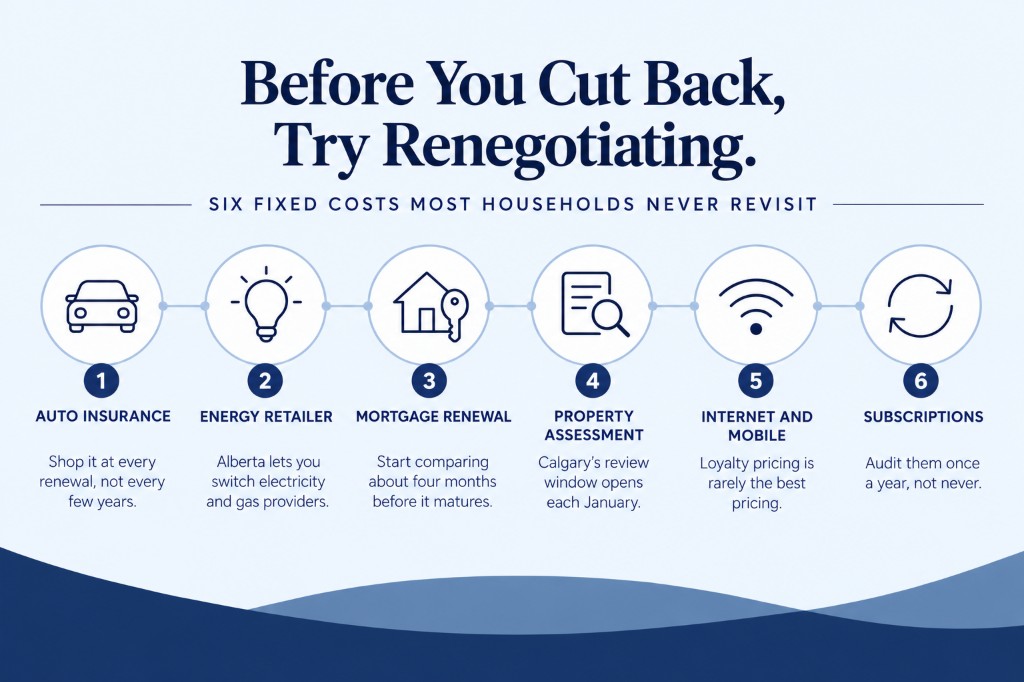
That means knowing your real numbers instead of your estimated ones, and periodically reviewing the fixed costs that quietly renew themselves every year whether you look at them or not.
It also means being honest about which of those three households you’re actually in. The approach that works for a renter with a flexible lease is not the approach that works for a family heading into a mortgage renewal.
If you’re not certain where you stand, that’s a reasonable thing to sit down and map out properly with someone. There are a few clear signs it’s worth doing.
Frequently Asked Questions
Is Calgary still an affordable city to live in?
Depends entirely on your reference point. Set against Toronto or Vancouver, yes, and comfortably so, helped by lower rents and the absence of both a provincial sales tax and a health premium. Measured against Calgary five years ago, no. Local inflation has been outrunning the national rate while Alberta wage growth slowed to roughly half the national pace.
What is Calgary’s living wage, and how is it different from minimum wage?
$26.50 an hour for 2025, up two dollars on the year. Vibrant Communities Calgary works it out as what a household actually needs to cover local costs without falling behind, and minimum wage sits at $15.00, so the gap is $11.50.
Why is Calgary’s inflation rate higher than the national average?
It hit 4.2 per cent year over year in July, against roughly three nationally. Transportation did most of that on its own, adding more than two percentage points to the Alberta figure. Shelter and food have been comparatively mild over the same stretch, which is partly why the squeeze is hard to point at.
Are rents in Calgary going up or down right now?
Down, and they have been for a while. One-bedrooms were asking about $1,508 in September, roughly five per cent below last year, and nationally asking rents have now fallen twenty-four months straight.
Has Alberta’s minimum wage changed recently?
No. It has been $15.00 an hour since October 2018, now among the lowest in the country. Eight years without a change. Prices obviously have not held still over that stretch. The distance between the legal floor and what a household actually needs has therefore widened every year since.
Who is feeling the squeeze most in Calgary right now?
It splits by household, and not evenly. Renters have gained ground as asking rents fall. Owners renewing a mortgage from the pandemic-rate era are absorbing payment increases that a one per cent dip in prices does nothing to offset. Families are carrying the most, because transportation, childcare and groceries are exactly the categories that moved.