
Summary
A good salary in Calgary depends on far more than the number on your paycheque. Housing costs, family size, debt, lifestyle, and savings goals can all change what feels comfortable. This guide looks at what salaries from $60,000 to $150,000 can mean after tax, and how to think about whether your income is actually supporting the life you want.
What counts as a “good” salary in Calgary depends a lot on your situation.
A single renter, a homeowner with a mortgage, and a family with childcare costs can all need very different incomes to feel comfortable.
A $60,000 salary might work well for someone with modest expenses and little debt, while the same salary could feel much tighter for someone supporting a family or carrying higher housing costs.
So instead of focusing on one magic number, it helps to look at what different salaries actually leave you with after tax, and how far that money may go once the usual monthly expenses are paid.

What Does a Good Salary Actually Mean?
When people ask what a good salary is, they usually are not asking whether they can technically survive on it.
They are asking whether they can live comfortably.
That might mean being able to pay the bills without worrying every month, put money into savings, go out for dinner occasionally, take a vacation, contribute to retirement, and still have a little breathing room.
For someone else, comfortable might mean buying a home, supporting children, or being able to invest aggressively.
That is why there is no single salary that works for everyone.
Your housing costs, debt, transportation, family size, lifestyle, and financial goals all matter.

What Do $60K, $80K, $100K and $150K Look Like After Tax?
One of the easiest mistakes to make when thinking about salary is focusing on the gross number.
A $100,000 salary does not mean you have $8,333 to spend every month.
Income tax, CPP, EI, workplace benefits, pensions, and other deductions all reduce what actually lands in your bank account.
For a typical Alberta employee, take-home pay might look roughly like this:
| Salary | Approx. annual take-home | Approx. monthly take-home |
|---|---|---|
| $60,000 | $47,000 to $48,000 | About $4,000 |
| $80,000 | $60,000 to $61,000 | About $5,000 |
| $100,000 | $74,000 to $75,000 | About $6,200 |
| $150,000 | $107,000 to $108,000 | About $9,000 |
These are only estimates. Your actual take-home pay can change depending on things like RRSP contributions, pension deductions, benefits, bonuses, tax credits, and other parts of your personal situation.
Still, they give us a much more useful starting point.
What Does a $60,000 Salary Feel Like in Calgary?
At $60,000 a year, you may take home somewhere around $4,000 a month.
For one person, that can be enough to live reasonably well if housing costs are under control.
You may be able to cover rent, groceries, transportation, insurance, and other regular expenses while still putting some money aside.
But there may not be a huge amount left over.
If rent is high, you have a car payment, or you are carrying credit card or line of credit debt, that $4,000 can disappear quickly.
For a family, $60,000 will generally feel much tighter because the same income has to cover more food, clothing, housing, transportation, and possibly childcare.
So $60,000 can absolutely be workable, but it may require a little more planning.
What About $80,000?
At $80,000, take-home pay moves closer to $5,000 per month.
That extra $1,000 or so each month can make a noticeable difference.
You may have more room to build an emergency fund, contribute regularly to a TFSA or RRSP, travel, or save toward a home.
It also gives you more flexibility when unexpected expenses come up.
That does not mean $80,000 automatically feels wealthy.
Housing is still one of the biggest expenses in Calgary, especially if you are renting alone or trying to buy a home.
But compared with $60,000, there is generally more room to make progress toward longer-term goals instead of simply covering the basics.
Is $100,000 a Good Salary in Calgary?
For many people, $100,000 feels like an important milestone.
It is a six-figure income, and it sounds like a lot of money.
After tax and payroll deductions, though, you might actually have somewhere around $6,200 per month to work with.
That is still a strong amount of income for many households.
A single person earning $100,000 may have a good amount of room for saving, investing, travel, hobbies, and other priorities.
But the experience can look very different for a family.
A mortgage, two vehicles, childcare, groceries, insurance, utilities, and children’s activities can take up a surprisingly large portion of that income.
This is why someone earning $100,000 can feel very comfortable, while someone else earning the exact same amount can feel stretched.
The salary is only one part of the picture.
What Does $150,000 Look Like?
At $150,000 a year, take-home pay may be close to $9,000 per month.
At this level, there is generally much more room to work toward several financial goals at the same time.
You might be able to invest regularly, pay down a mortgage faster, save for your children’s education, travel more often, or build retirement savings more aggressively.
But higher income does not automatically mean stronger finances.
It is very easy for expenses to rise along with income.
A more expensive home, newer vehicles, frequent travel, subscriptions, restaurants, and other lifestyle upgrades can gradually use up the extra money.
Someone earning $150,000 can still feel like they are living paycheque to paycheque if their spending grows just as quickly as their income.
Housing Changes Everything
Housing is probably one of the biggest reasons it is so difficult to put a single number on a “good salary” in Calgary.
Imagine two people who both earn $100,000.
One rents an apartment for $1,800 a month.
The other owns a home and is paying a $3,500 mortgage, property tax, home insurance, utilities, and maintenance.
Their salaries are identical, but their financial lives may feel completely different.
The same is true for someone who bought a home years ago compared with someone entering the market today.
Housing can easily be the difference between feeling comfortable and feeling stretched.

Family Size Matters Too
A good salary for one person is not necessarily a good household income for four people.
A single person may be able to live comfortably on $70,000 or $80,000.
Add a partner and children, and the numbers can change very quickly.
Families often have larger grocery bills, higher housing costs, childcare expenses, activities, clothing, insurance, and more transportation costs.
That does not necessarily mean families need extremely high incomes to live well.
It simply means household income has to be looked at alongside household expenses.
For couples, it can also make more sense to think in terms of total household income rather than comparing each salary individually.
Two people earning $70,000 each are in a very different financial position than one person earning $70,000 while supporting the entire household.
So How Much Do You Need to Live Comfortably in Calgary?
There is no perfect answer, but we can think about it in broad terms.
Around $60,000 may be manageable for a single person with reasonable housing costs and limited debt.
Around $80,000 gives you more room for saving, investing, and enjoying your income.
At $100,000, many people will have considerably more flexibility, although housing and family expenses can still take up a large portion of monthly income.
At $150,000, there is generally much more capacity to build wealth and work toward several goals at once.
But none of these numbers guarantee that you will feel comfortable.
A person earning $80,000 with low expenses may be in a stronger financial position than someone earning $150,000 with a large mortgage and a lot of debt.
Your Salary Matters, but What You Do With It Matters Too
Earning more can obviously make life easier.
But there is another side to the equation.
What happens to the money once you earn it?
As your income grows, you may have opportunities to increase RRSP contributions, use your TFSA more effectively, pay down debt, invest, or save for larger goals.
You also have more opportunities to spend.
That is where having some kind of plan becomes valuable.
A raise does not always need to mean a nicer car or a more expensive lifestyle.
Maybe part of it goes toward retirement.
Maybe it helps pay off your mortgage faster.
Maybe it gives you the freedom to travel more.
Maybe it simply gives you a larger emergency fund and less financial stress.
The important part is deciding where you want the money to go instead of wondering where it went at the end of the month.
The Bottom Line
So, what is a good salary in Calgary in 2026?
There really is not one number.
For some people, $60,000 is enough to live comfortably.
For others, even $100,000 can feel tight once housing, family expenses, and debt are taken into account.
What matters more is the relationship between your income and your expenses.
How much comes in?
How much goes out?
How much are you able to save or invest?
And most importantly, is your income helping you build the kind of life you actually want?
That gives you a much better answer than comparing your salary with someone else’s.
Frequently Asked Questions
How much of my salary should go toward housing in Calgary?
There is no perfect percentage for everyone, but housing should leave enough room in your budget for food, transportation, debt payments, savings, and everyday spending. Someone with few other expenses may comfortably spend more on housing than someone with childcare costs, loans, or other major commitments.
Should I compare salaries before tax or after tax?
Gross salary is useful when comparing job offers, but take-home pay is usually more helpful for your personal budget. Taxes, CPP, EI, pensions, benefits, and other payroll deductions determine how much money actually reaches your bank account.
Is household income more important than individual salary?
For couples and families, household income often gives a clearer picture. Two people earning moderate salaries may have more financial flexibility than a household relying on one higher salary, depending on childcare, housing, debt, and other expenses.
What should I look at besides salary when comparing jobs?
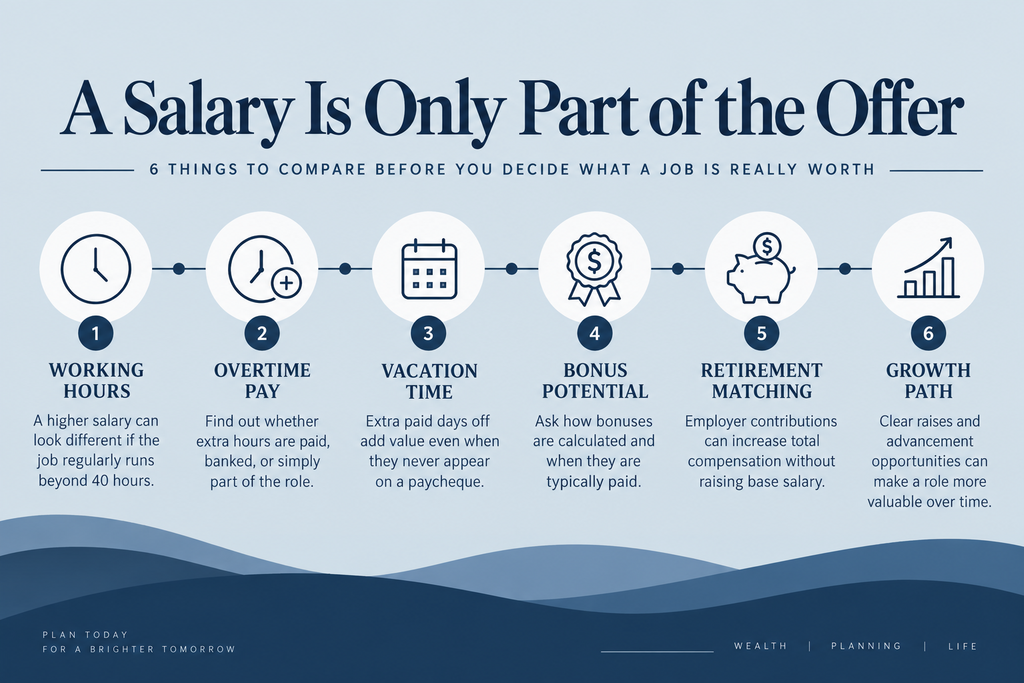
Salary is only one part of compensation. Vacation time, bonuses, pension or retirement matching, health benefits, overtime policies, flexible work arrangements, and opportunities for raises can all affect what a job is really worth.
Does earning more always mean much more take-home pay?
You still take home more money when your salary increases, but not every additional dollar is taxed at the same rate. Canada uses a progressive tax system, meaning higher tax rates apply only to portions of income that fall into higher tax brackets.
How can I tell if my salary is actually enough for my lifestyle?
Start with your monthly take-home pay and subtract your real expenses, including housing, transportation, groceries, debt payments, insurance, and regular savings. What remains gives you a much better idea of how comfortable your income actually is than the salary number alone.