
Summary
A two-bedroom apartment costs about $1,834 a month in Calgary, $2,937 in Toronto and $3,271 in Vancouver. Over a year, that’s a $17,000 gap between Calgary and Vancouver on rent alone. Add a sales tax Alberta doesn’t charge and a benchmark home price that’s roughly half Vancouver’s, and the same salary buys a noticeably different life depending on which airport you land at.
People move between these three cities constantly, usually for a job, and usually with a rough sense that one is cheaper than the others.
Rough senses are expensive. Here are the actual numbers, all from September 2026. If you want the Calgary picture on its own, we covered what it costs to live here separately.
Rent Is Where the Gap Opens Up
Start with the thing most people pay every month.
A one-bedroom averages $1,508 in Calgary. Toronto asks $2,220 for the same thing, and Vancouver $2,373.
Move up to two bedrooms and the spread widens considerably. Calgary sits at $1,834, Toronto at $2,937, Vancouver at $3,271.
That last pair is worth sitting with. A Vancouver two-bedroom costs $1,437 more every month than the Calgary equivalent, which is $17,244 over a year, after tax, out of money you’ve already been taxed on.
Every one of these markets is softening, incidentally. Calgary’s one-bedrooms are down five per cent year over year, Vancouver’s down 4.7, Toronto’s down 2.3. The gap is closing slightly. It is not closing quickly.

Buying Is Where It Stops Being Close
The rental gap is significant. The ownership gap is a different category of thing.
CREB’s benchmark for a typical Calgary home was $566,700 in September. The Toronto area benchmark was $917,600. Metro Vancouver’s was $1,075,900.
Vancouver detached is a number most people can’t act on at all: $1,784,700.
That is more than three times the Calgary benchmark for an entire market, not a luxury tier.
Here’s the part that gets missed, though. Every market here is falling, and the expensive ones are falling faster. Vancouver is down 5.5 per cent on the year, Toronto down 4.7, Calgary down just under one.
Calgary’s advantage is real. It’s also narrowing, slowly, from the other direction.
The Down Payment Tells the Story Fastest
Forget monthly payments for a second and look at the cash you need at the door. Minimum down payment rules are federal, so they’re identical in all three cities. Five per cent on the first $500,000, ten per cent on the portion above it.
Applied to the Calgary benchmark, that’s $31,670. The Toronto equivalent is $66,760. Vancouver’s is $82,590.
So the entry ticket in Vancouver is more than two and a half times Calgary’s. For a household saving a few hundred a month, that isn’t a slightly longer wait. It’s a different decade. The lender math behind those numbers works the same way in every province, and we walked through exactly how lenders actually calculate them.

The Sales Tax Alberta Does Not Charge
This one compounds quietly in the background and almost nobody factors it in.
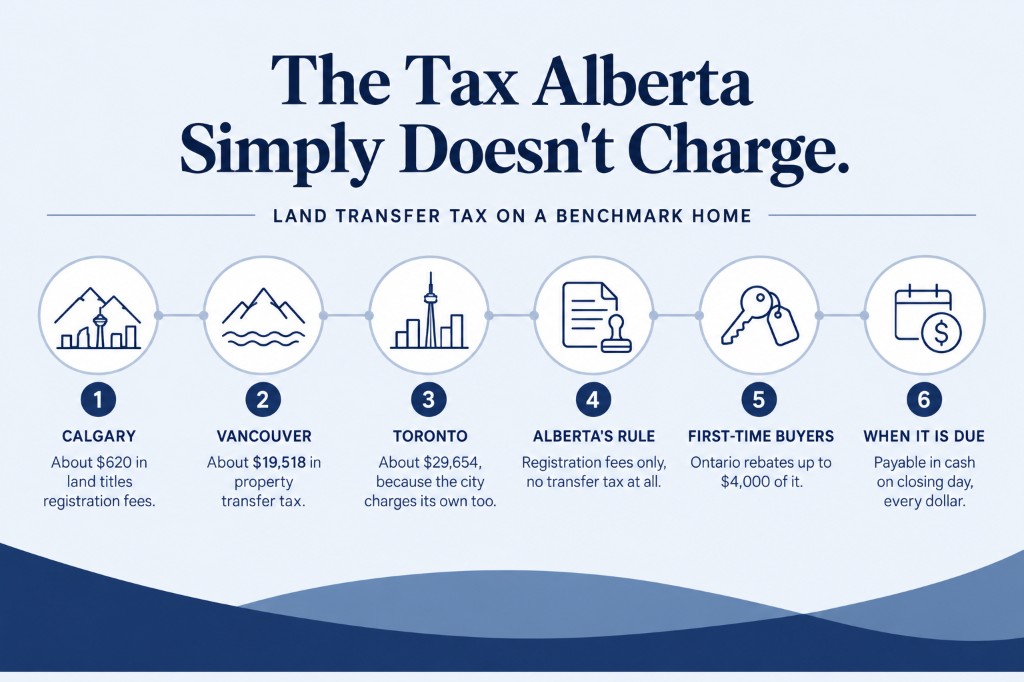
Alberta charges five per cent GST and nothing else. British Columbia adds a seven per cent provincial sales tax, for twelve. Ontario runs a thirteen per cent harmonized tax.
Take a household putting $30,000 a year through taxable purchases, so furniture, electronics, restaurants, clothing, services, the things that aren’t groceries or rent.
A Calgary household pays $1,500 of tax on that. Vancouver pays $3,600, Toronto $3,900.
Call it $2,400 a year that simply never leaves an Alberta household’s account. Nobody notices it, because it’s distributed across hundreds of small transactions, but it’s real money and it recurs forever.
Where Calgary Is Actually More Expensive
It would be dishonest to run this comparison without the other direction.
There are two, and the second is worse than people expect.
Transit is the clearest example. A single adult fare in Calgary is $4.00. In Toronto it’s $3.30 with a Presto card. Calgary charges more per ride than the largest transit system in the country.
Car insurance is the bigger one. Alberta’s average premium was about $1,820 a year in 2025, which is high. Ontario is higher still at roughly $2,117. British Columbia’s system works differently enough that the figures aren’t directly comparable, but Alberta is not the cheap option here by any measure.
And Calgary is a city where most households need a vehicle. Toronto and Vancouver both have transit networks dense enough that going car-free is genuinely practical for a lot of people. That’s a real cost Calgary quietly adds back.
Same Salary, Different Life
Take a household on $120,000 and drop it into a two-bedroom in each city.
Rent eats about $22,000 a year in Calgary. In Toronto that same household hands over $35,200, and Vancouver pushes past $39,000.
Nobody has bought groceries yet and the Calgary household is already ahead by $13,000 to $17,000. Layer the sales tax difference on top and you’re closer to $15,000 to $19,500.
That’s not a lifestyle adjustment. That’s the difference between contributing to an RRSP every year and intending to.

What the Comparison Leaves Out
Numbers like these are clean in a way that real life isn’t.
Salaries aren’t identical across the three cities, and in some industries the Toronto or Vancouver premium closes a meaningful part of the gap. Commute times differ. So does weather, which costs money here in ways it doesn’t on the coast.
Family matters too, and it doesn’t show up in any of this. Living three hours from people who can watch your kids is worth something a spreadsheet won’t capture.
And a cheaper city only stays cheaper if your spending doesn’t expand to fill the room. Plenty of people move to Calgary, buy a bigger house and a second vehicle, and end up in precisely the same place.
So Is It Worth Moving?
Strictly on the arithmetic, Calgary wins, and it isn’t particularly close.
Roughly half the benchmark home price of Vancouver. Nearly forty per cent less on rent than Toronto. No provincial sales tax. A down payment you could realistically assemble rather than inherit.
What the math can’t tell you is whether the saving survives contact with your actual habits, or whether the thing you’d be giving up matters more than the money.
The useful version of this question isn’t which city is cheaper. It’s what you would actually do with the difference if you captured it. If the honest answer is that you’d spend it, the gap closes faster than any of these numbers suggest, and Calgary stops feeling affordable regardless of what the data says.
Frequently Asked Questions
Is Calgary cheaper than Vancouver and Toronto?
Yes, and not by a small margin. September two-bedrooms came in at $1,834 here against $2,937 in Toronto and $3,271 in Vancouver. Buying is where it really separates though, at $566,700 versus $917,600 and $1,075,900. Transit fares and car insurance are the two places Calgary loses.
How much cheaper is rent in Calgary than Vancouver?
About $1,437 a month on a two-bedroom. Over a year that’s $17,244 you simply never spend.
How much down payment do you need in each city?
Same rules everywhere, because the tiers are federal. Five per cent on the first $500,000, ten on anything above it. What changes is the price those percentages attach to, which works out to roughly $31,670 in Calgary, $66,760 around Toronto and $82,590 in Metro Vancouver.
How much does Alberta’s lack of a provincial sales tax actually save?
Alberta charges GST and stops there. British Columbia stacks seven points on top of it, and Ontario runs thirteen all in. Push $30,000 of taxable spending through a year and you’re looking at roughly $1,500 in tax here, $3,600 in Vancouver, $3,900 in Toronto. Call it $2,400 annually. You’d never feel it as a single bill, which is exactly why nobody budgets for it.
Is anything actually more expensive in Calgary?
Two things, and both are real. A ride costs $4.00 here against $3.30 in Toronto. Alberta car insurance averaged $1,820 in 2025, in a city where going without a vehicle isn’t realistic for most households.
Are home prices falling in all three cities?
All three, yes. The interesting part is that the expensive markets are falling fastest. Vancouver dropped 5.5 per cent year over year in September, Toronto 4.7, Calgary less than one. The gap is closing, just slowly.