
Summary
Calgary is still cheaper than Toronto or Vancouver, but cheaper and cheap aren’t the same thing. Rent has actually come down over the past year. Groceries have gone the other way. And a few costs that catch people out, like car insurance, winter heating and property tax, don’t really register until the bill lands. So here’s the real arithmetic for 2026, and what it comes to each month for one person, for a couple, and for a family of four.
Nobody quite agrees on what it costs to live in Calgary.
And they’re all right, more or less. The number swings on three things: whether you rent or own, whether you drive, and whether anyone in the house is under six.
Everything below is current to September 2026. The numbers come from CREB, Statistics Canada, Calgary Transit, the province and Canada’s Food Price Report, so they’re real. They’re also averages. Yours will be different.
Housing Is Still the Line That Decides Everything
For renters, there’s been some relief.
A two-bedroom apartment is asking about $1,890 a month, according to Statistics Canada, and that’s down roughly six per cent in a year. One-bedrooms sit closer to $1,575.
That’s unusual. Calgary saw the largest decline among the country’s six biggest rental markets over the past year, which is not a sentence anyone was writing in 2023.
Buying has softened too. A typical Calgary home benchmarked at about $569,200 in July, down a couple of per cent on the year. Break that out and a detached home sits near $743,900, a row house near $418,500, and an apartment condo near $297,600. Condos have fallen hardest, down more than eight per cent, as supply has piled up.
What a benchmark price doesn’t tell you is the monthly cost. That depends on your down payment and your rate, and it’s worth running those numbers before you fall in love with a listing. If you’re weighing a purchase against other uses for the same money, we looked at whether to pay down your mortgage or invest separately.

Groceries Have Gone the Other Way
Canada’s Food Price Report expects food prices to rise another four to six per cent in 2026, with meat leading at five to seven per cent. Alberta is forecast to see above-average increases this year.
In dollars, the report puts annual food spending for a family of four at up to roughly $17,570. That’s about $1,460 a month, and close to $995 more than the same family spent in 2025.
For one adult it’s nearer $4,000 to $4,500 a year, or $335 to $375 a month.
Those figures assume you’re cooking. Add takeout and the number moves quickly.

Utilities Swing More Than People Expect
This is the category that ruins budgets built in July.
Alberta averages land somewhere around $105 a month for electricity, $40 for natural gas, $78 for water and $74 for internet. Bundled together, call it $250 to $300 for an apartment.
But those are averages across a whole year. A January gas bill in a detached house can be several times a July one, and the fixed delivery charges on an Alberta utility bill often add up to more than the energy you actually used.
If you’re moving here, budget for the winter number, not the annual average.
Getting Around Got More Expensive in January
Calgary Transit raised fares in January. A single adult ride is $4.00 now, and a monthly pass is $126. Youth passes went to $92 in September.
Driving is a different story. The average Alberta auto premium runs $1,835 a year, second highest of any province according to the Automobile Insurance Rate Board. That’s about $153 a month before you’ve bought a single litre of fuel.
Add fuel, parking, maintenance and registration on top, and one car usually costs a household somewhere between $350 and $450 a month.
Childcare Is the One Thing That Got Cheaper
Since April 2025, Alberta has used a flat fee.
Licensed daycares and day homes with an affordability grant charge $326.25 a month for full-time care, or $230 a month for part-time, for children kindergarten age and under.
That’s a significant change from a few years ago, when Calgary parents were routinely paying well over $1,000 a month per child. Optional extras like meals or transportation can still be billed separately, and not every provider takes part in the program.
Entertainment and Everything Else
There’s no official number here, and anyone who hands you one is guessing.
Phone plans, streaming, a gym membership, dinner out, a ski pass, a season of minor hockey. Most Calgary households land somewhere between $300 and $700 a month on this category.
It’s usually the first place people look when money gets tight, and the category most likely to quietly grow when it doesn’t.
So What Does It Actually Add Up To?
Here’s what the pieces look like assembled. These are illustrative rather than quotes, and every one of them moves depending on your neighbourhood and your habits.
A Single Person
Renting a one-bedroom at $1,575, with $250 for utilities and internet, $350 for groceries, a $126 transit pass, $60 for a phone and $300 for everything else, you’re at roughly $2,660 a month.
Swap the transit pass for a car and it’s closer to $3,000.
A Couple
Two people in a two-bedroom at $1,890, plus $300 for utilities and internet, $710 for groceries, one car at around $400, $110 for phones and $500 for entertainment, comes to about $3,900 a month.
Two incomes make that far more comfortable than the single-person figure, which is most of the reason the math works better for couples.
A Family of Four
Take that same two-bedroom, knowing a three-bedroom or a detached home costs more. Add $350 for utilities and internet, the food report’s $1,460 for groceries, $326 for one child in full-time care, $400 for a car, $150 for phones and $500 for activities.
That’s roughly $5,080 a month, before a mortgage, before RESP contributions, and before anything goes into savings.
What Calgary Still Has Going For It
Alberta has no provincial sales tax, so the sticker price is close to what you actually pay, and there’s no health-care premium either.
Put that alongside rents that have genuinely fallen and the gap with Toronto or Vancouver is real.
But it’s a gap, not a free pass. Car insurance, utilities and property tax all run higher here than newcomers expect, and those are exactly the costs nobody puts in the first draft of a budget. They’re also among the financial mistakes Calgary families make most often.
Building a Budget That Survives February
The number that matters isn’t the average. It’s yours.
Most people who feel stretched aren’t overspending in any obvious way. They’ve built a budget around a good month, and then the insurance renewal, the winter gas bill and the vehicle registration all land inside the same six weeks.
The fix is unglamorous. Take your real twelve-month totals, divide by twelve, and set money aside every month for the bills that only appear occasionally. Tax works the same way. There are ways to reduce your tax bill before the end of the year that are far easier to act on in October than in March.
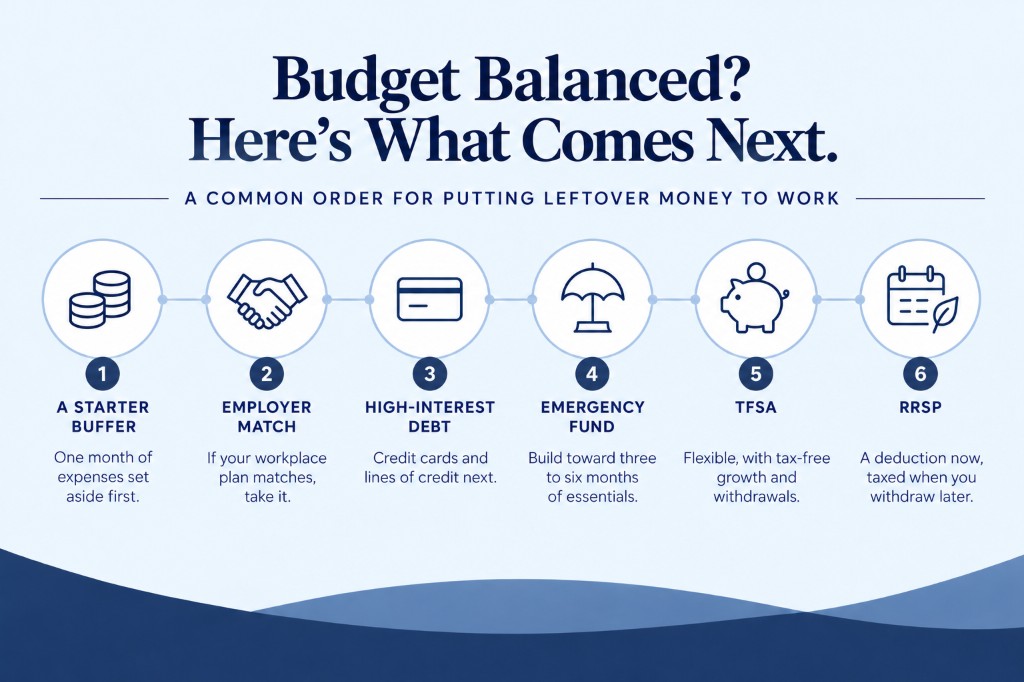
Once you have a number that holds up, the more interesting question is what to do with whatever’s left over. That’s where a financial advisor can help you work out the order to tackle things in, and how much of the surplus should be sitting somewhere other than a chequing account. If you’re not sure you’re at that stage yet, there are nine signs it may be time to talk to one.
Frequently Asked Questions
How much money do you need to live comfortably in Calgary in 2026?
It depends heavily on your household. Using current figures, a single person renting a one-bedroom and taking transit lands around $2,660 a month, a couple sharing a two-bedroom with one car is near $3,900, and a family of four with one child in full-time care is around $5,080 before any mortgage or savings. Those are illustrative totals, not quotes.
Is Calgary cheaper than Toronto or Vancouver?
Generally yes, and the gap widened over the past year. Calgary saw the largest rental decline among Canada’s six biggest markets, and Alberta has no provincial sales tax and no health-care premium. The offset is that car insurance, utilities and property tax tend to run higher here than newcomers expect.
How much is rent in Calgary right now?
Statistics Canada put the average asking rent for a two-bedroom apartment in Calgary at roughly $1,890 a month in the second quarter of 2026, down about six per cent year over year. One-bedrooms are closer to $1,575. Rent varies widely by neighbourhood and by how recently the unit was listed.
How much does childcare cost in Calgary?
Alberta moved to a flat fee in April 2025. Licensed daycares and day homes with an affordability grant charge $326.25 a month for full-time care and $230 a month for part-time care, for children kindergarten age and under. Meals, transportation and other optional services can be billed on top, and not every provider takes part.
Why are Alberta car insurance and utility bills higher than people expect?
The Automobile Insurance Rate Board put the average Alberta auto premium at $1,835 a year, the second highest in the country. Utility bills carry fixed delivery and administration charges that can add up to more than the energy itself, and natural gas use swings sharply between summer and winter, so an annual average understates what you pay in January.
Is it cheaper to rent or buy in Calgary in 2026?
There’s no single answer, because a mortgage payment depends on your down payment and your rate. CREB’s benchmark for a typical Calgary home was about $569,200 in July 2026, with apartment condos near $297,600 and detached homes near $743,900. Owning also brings property tax, home insurance, maintenance and, for condos, monthly fees, which rent does not.