
Summary
A little planning before the end of the year can help you avoid paying more tax than necessary. Things like reviewing your RRSP contributions, checking your TFSA room, looking at investment gains or losses, and organizing eligible expenses can all make a difference. The best approach depends on your income, investments, and overall financial situation.
Nobody wants to pay more tax than they have to.
The good news is there are a few things you can look at before the year ends that could make a difference when tax season rolls around. The key is doing it early enough. Waiting until you’re sitting down to file your return can mean some opportunities have already passed.
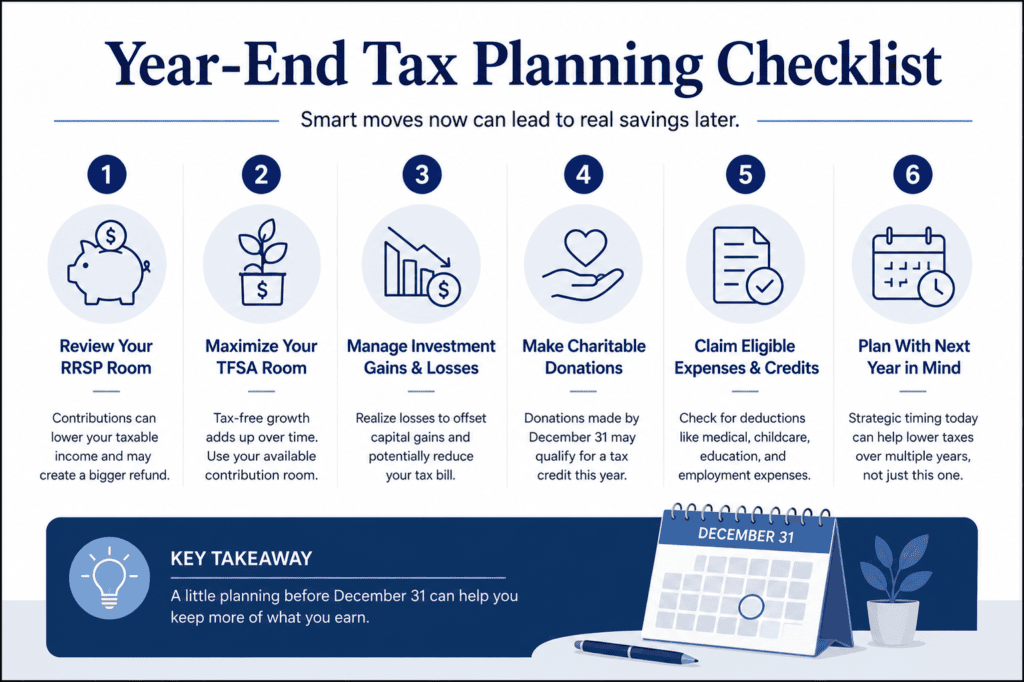
Here are a few areas worth looking at before December 31.
Take a Look at Your RRSP
An RRSP contribution can reduce your taxable income, which is one reason it’s such a common part of year-end tax planning.
How useful that contribution is depends on your income, available contribution room and overall situation. In some cases, it may even make sense to contribute now but save the deduction for a future year when your income is higher.
There’s also no need to wait until the RRSP deadline to think about it. Looking at your options before the end of the year gives you more time to decide what actually makes sense.
Make Sure You’re Using Your TFSA
A TFSA contribution won’t give you a tax deduction today, but that doesn’t make it any less useful.
Investment growth inside a TFSA is generally tax-free, and withdrawals are generally tax-free as well.
If you have unused contribution room and money sitting in a regular savings or investment account, it may be worth asking whether some of it would be better off inside your TFSA.
Just make sure you know how much contribution room you have before moving money around. Overcontributing can result in penalties.

Look at Investments That Have Lost Value
Nobody likes seeing an investment lose money, but sometimes a loss can still be useful from a tax perspective.
If you have investments outside of registered accounts that have dropped in value, selling them may create a capital loss. That loss can potentially be used against taxable capital gains.
There are rules around how this works, including what happens if you buy the same investment back shortly afterward, so this is one area where getting advice before making a move can be worthwhile.
Don’t Leave Donations Until the Last Minute
If you were already planning to donate to a charity, making the donation before the end of the year may allow you to claim the charitable donation tax credit for that year.
It’s also worth keeping your receipts somewhere you can actually find them later. It sounds simple, but tracking down a year’s worth of receipts in April isn’t much fun.
Depending on what you’re donating, there may also be different ways to structure the gift. For larger donations, it can be worth discussing your options with an advisor or tax professional.

Check for Expenses and Credits You Might Be Missing
Tax returns can get complicated quickly, and it’s surprisingly easy to overlook something you may be able to claim.
Depending on your situation, there may be credits or deductions related to medical expenses, childcare, employment expenses, education, moving expenses or other costs you had during the year.
Not all of these will apply to everyone, but reviewing them before tax season gives you time to find the paperwork you need.
Think About Next Year Too
Year-end tax planning isn’t only about trying to save money on this year’s return.
Sometimes the better decision is one that helps over several years.
For example, using an RRSP deduction this year may make sense, or you may be better off carrying it forward. Realizing an investment gain in December versus January can put that income in a different tax year. Even the timing of certain expenses can matter.
This is where looking at your finances as a whole becomes much more useful than trying to make a few last-minute moves in December.
A Little Planning Can Go a Long Way
You don’t need to completely reorganize your finances every December.
Sometimes it’s simply a matter of checking your RRSP and TFSA, reviewing your investments, gathering receipts and making sure you haven’t missed anything important.
The earlier you do that, the more options you usually have.
And if your finances have changed during the year, maybe you earned more, sold an investment, bought a property, started a business or are getting closer to retirement, it can be a good time to talk with your financial advisor and tax professional.
A little planning before December 31 can make tax season a lot less surprising.
Frequently Asked Questions
What can I do before the end of the year to reduce my tax bill?
Year-end tax planning may include reviewing your RRSP contributions, making use of available TFSA room, looking at investment gains and losses, making planned charitable donations, and organizing receipts for eligible deductions and tax credits. Which strategies make sense will depend on your income, investments and overall financial situation.
Can an RRSP contribution reduce my income tax?
An eligible RRSP contribution can reduce your taxable income when you claim the deduction. The amount you can contribute and deduct depends on your available RRSP contribution and deduction room. In some situations, you may also choose to make a contribution now and claim the deduction in a future year.
Does contributing to a TFSA reduce my taxable income?
No. TFSA contributions are not tax deductible. However, investment income and growth earned inside a TFSA are generally tax-free, and withdrawals are generally tax-free as well. Before contributing, it is important to confirm that you have enough available contribution room.
Can investment losses help reduce my taxes?
Capital losses from investments held outside registered accounts may be used to offset taxable capital gains, subject to applicable tax rules. There are also rules that can prevent a loss from being immediately claimed if you or an affiliated person repurchases the same or identical investment around the time of the sale.
Can charitable donations help reduce my tax bill?
Eligible charitable donations can provide federal and provincial or territorial donation tax credits. If you are already planning to donate, the timing of the donation can affect the tax year in which it may be claimed. Keeping your official donation receipts organized can also make tax filing easier.
Why should I review my taxes before the end of the year?
Some tax-planning opportunities depend on when a transaction or expense occurs. Reviewing your finances before year-end gives you more time to consider your RRSP, investments, donations, expenses and other potential tax strategies instead of discovering missed opportunities when you file your return.