
Summary
If you have extra money available, deciding whether to put it toward your mortgage or invest it can be a tough call. Paying down your mortgage can reduce interest and give you more peace of mind, while investing gives your money more opportunity to grow over time. For many people, the best answer is not one or the other, but a mix that fits their goals, timeline, and comfort with risk.
It’s a question a lot of homeowners eventually run into.
You have some extra money sitting there, or maybe your income has gone up a bit, and you start wondering what would actually be smarter. Put more on the mortgage? Or invest it?
There isn’t one answer that works for everyone. A lot depends on what matters most to you, how much risk you’re comfortable with, and where you are financially right now.

Why Paying Down the Mortgage Is So Appealing
For some people, this is an easy choice.
They hate debt. They want the mortgage gone. Every extra payment feels like progress, and there’s a lot of comfort in knowing you’re getting closer to owning your home outright.
There’s also a very real financial benefit. The less you owe, the less interest you pay over time.
If your mortgage rate is on the higher side, paying it down faster can be even more attractive.
And honestly, there’s something to be said for peace of mind. Going into retirement with little or no mortgage payment can make monthly expenses a lot easier to handle.
Why You Might Invest Instead
The other side of the argument is that your money may have more room to grow if you invest it.
If you’re still years away from retirement, you may have time on your side. That can make investing more appealing, especially if you already have room in your TFSA or RRSP.
The idea is pretty simple. If your investments grow at a higher rate than what you’re paying in mortgage interest, you could come out ahead over time.
Of course, that’s not guaranteed.
Investments move up and down. Some years are great, others are not. That uncertainty is a big reason why some people would still rather put extra money into their home.
A Lot Depends on Your Mortgage Rate
Your mortgage rate matters quite a bit here.
If you have a very low rate, you may not feel much pressure to pay the mortgage down faster. You might be more comfortable investing that money and letting it grow.
If your rate has jumped after a renewal, the decision can feel very different.
Suddenly, paying down the mortgage gives you a bigger guaranteed saving on interest, which can be hard to ignore.
Still, your mortgage rate shouldn’t be the only thing you look at.

Don’t Forget About Everything Else
Before throwing extra money at the mortgage, it’s worth looking at the rest of your finances too.
Do you have an emergency fund?
Are you carrying credit card debt or other higher-interest debt?
Are you already contributing to your TFSA or RRSP?
Do you expect any large expenses in the next few years?
These things can matter just as much as the mortgage itself.
For example, paying down your mortgage aggressively might feel great, but not if it leaves you short on cash when you suddenly need a new furnace or have an unexpected expense.
You Can Do Both
This part often gets overlooked.
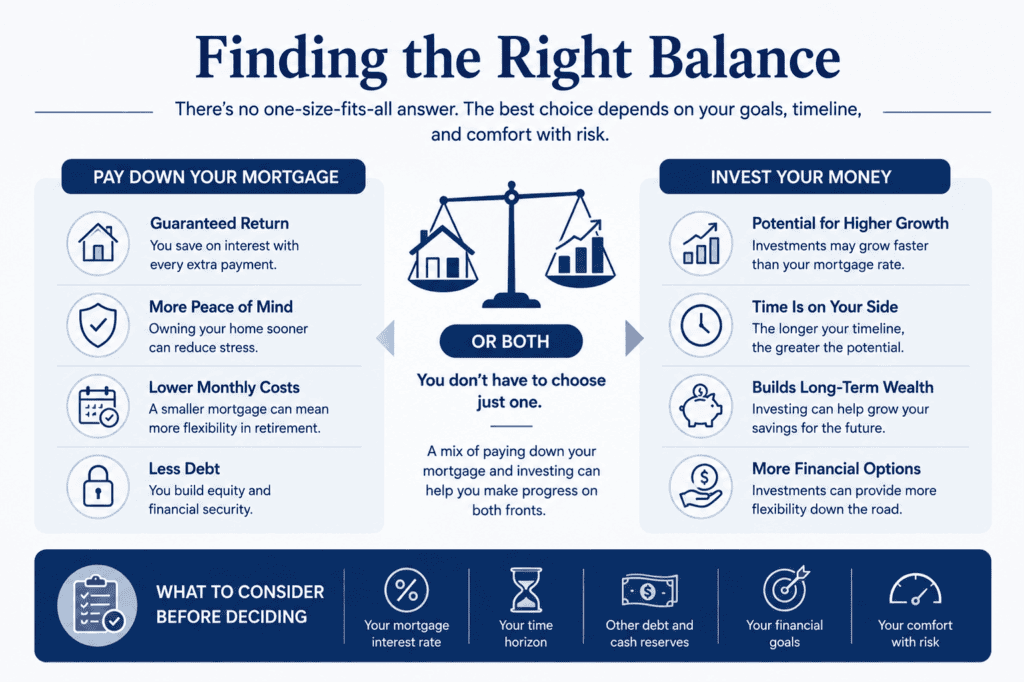
You don’t actually have to choose one side.
You could put some extra money on the mortgage and invest the rest.
That might mean increasing your regular mortgage payment a little while still contributing to your TFSA every month.
For a lot of people, that feels like the best of both worlds. You’re reducing debt, but you’re also not putting your investing completely on hold.
What Would Make You Feel Better?
This is where the decision becomes personal.
Some people sleep better knowing they owe less on their house.
Others feel better knowing they have a larger investment account and more money working for them.
Neither one is automatically better.
The math matters, but your comfort level matters too.
A strategy that looks perfect on paper isn’t very useful if it makes you nervous every time the market drops or every time your mortgage renewal comes around.
The Bottom Line
If you’re stuck between paying down your mortgage or investing, start by looking at the full picture.
Your mortgage rate matters. So does your timeline, your savings, your other debt, your retirement plans, and how comfortable you are with risk.
For some people, paying the mortgage faster will make the most sense.
For others, continuing to invest will be the better fit.
And for plenty of people, doing a bit of both is probably the most realistic answer.
The important part is having a plan that actually fits your life, not just one that sounds good on paper.
Frequently Asked Questions
Is it better to pay down your mortgage or invest?
There is no single answer that works for everyone. Paying down your mortgage reduces the amount of interest you will pay and provides a guaranteed financial benefit, while investing gives your money the potential to grow over time. Your mortgage rate, investment timeline, financial goals and comfort with risk should all factor into the decision.
When does paying down a mortgage make more sense?
Paying down your mortgage may be more attractive when your mortgage rate is relatively high, you want to reduce your monthly expenses before retirement, or becoming debt-free is an important personal goal. It can also provide peace of mind because reducing mortgage debt does not depend on investment market performance.
When might investing be the better choice?
Investing may be more appealing when you have a long investment timeline, a relatively low mortgage rate and available contribution room in accounts such as a TFSA or RRSP. Investments can potentially generate greater long-term returns than the interest saved by paying down a mortgage, although investment returns are not guaranteed.
Should I pay off higher-interest debt before making extra mortgage payments?
Higher-interest debt, such as credit card debt, is worth considering before making additional mortgage payments. Because this debt often carries a much higher interest rate than a mortgage, reducing it may have a greater immediate financial benefit.
Should I have an emergency fund before paying extra on my mortgage?
Maintaining accessible emergency savings can be important before putting a significant amount of extra cash toward your mortgage. Once money is used to reduce your mortgage balance, it may be more difficult to access if you suddenly need funds for a major repair, job loss or unexpected expense.
Can I pay down my mortgage and invest at the same time?
Yes. You do not necessarily have to choose one strategy exclusively. You could divide your available money between additional mortgage payments and regular investments. This approach allows you to reduce debt while continuing to build your investments for longer-term goals.